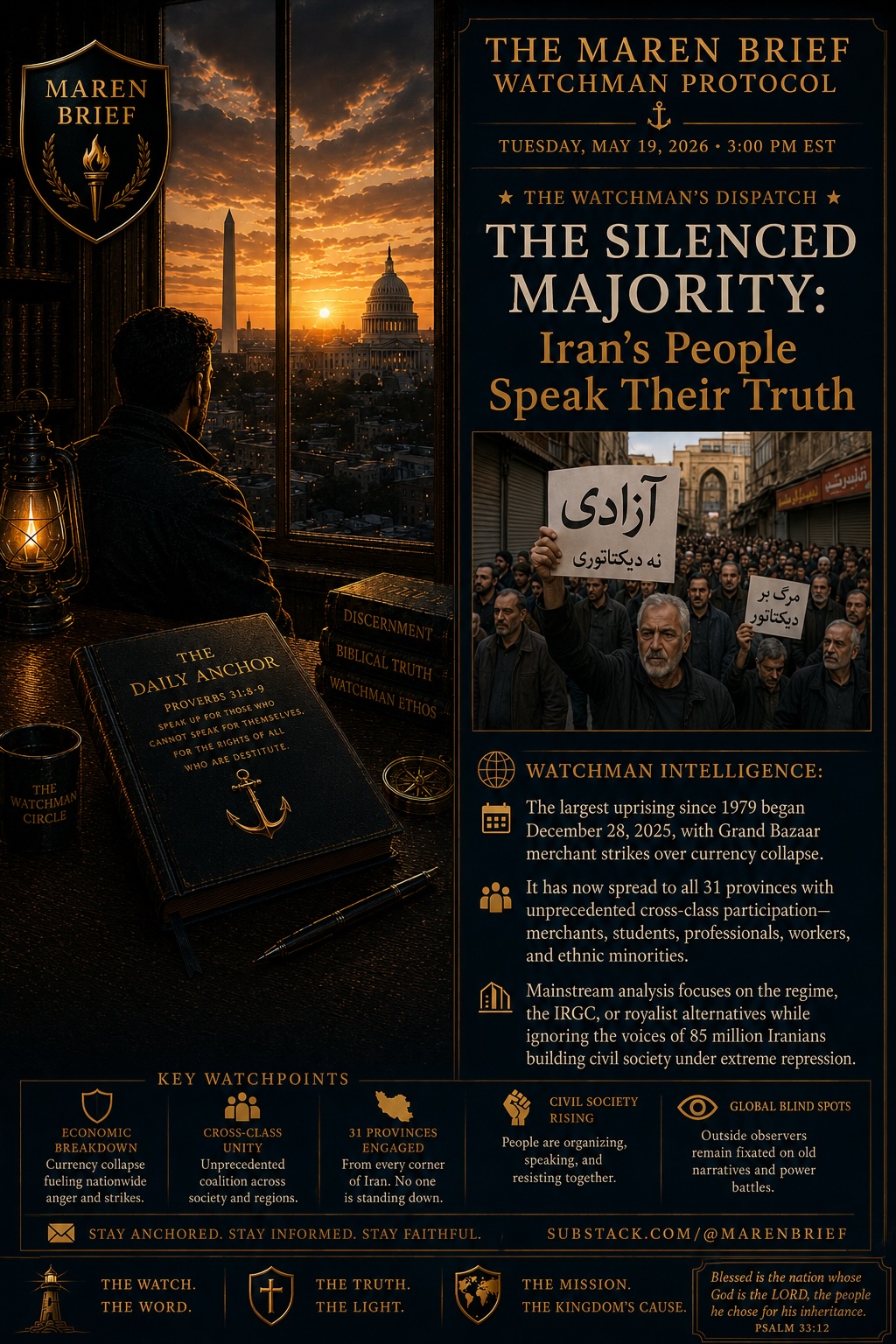
On December 28, 2025, merchants at Tehran's Grand Bazaar shuttered their shops over a currency collapse. Within forty-eight hours, the protests had spread to Isfahan, Shiraz, and Mashhad. Within two weeks, demonstrations had reached all thirty-one Iranian provinces. By late January, credible monitors were counting the dead in the thousands.
Five months later, the story remains incompletely told. Most global coverage of Iran still routes through three voices — the Islamic Republic itself, the Israeli and American security communities watching it, and the exiled opposition speaking from Los Angeles, Toronto, and Berlin. The 85 million Iranians actually building civil society inside the country, under conditions no Western reader experiences, remain largely missing from the conversation.
What Is Different This Time
Iran has seen protest waves before. The 2009 Green Movement was carried by the urban middle class. The 2017-18 protests came from the economically marginalized. The 2022 Woman Life Freedom uprising centered on a generation of young women demanding the end of compulsory hijab and the morality police.
The 2025-26 wave is different in three measurable ways.
First, the bazaar broke. Tehran's merchant class — the same constituency that helped install the Islamic Republic in 1979 — is the constituency that triggered the current uprising. Forty-six years of regime support ended in a single week when the central bank eliminated preferential foreign exchange rates and the rial collapsed to 1.4 million per dollar.
Second, the convergence is cross-class and cross-ethnic. Industrial workers and bazaaris. Teachers and students. Pensioners and professionals. Kurdish and Baloch regions long suffering political exclusion. Women's organizations and labor unions. Filmmakers and university faculty. The breadth of participation exceeds anything Iran has seen since 1979.
Third, internal pressure and external weakness are arriving together. The June 2025 confrontation with Israel exposed military vulnerabilities the regime had spent decades concealing. Hezbollah's degraded position in Lebanon, the loss of Assad in Syria, and the strain on Iran's proxy network had already reshaped Iran's regional standing before the currency collapse pushed the streets past their breaking point.
The Civil Society the World Isn't Hearing
In early January 2026, a remarkable thing happened that received almost no international coverage. Iranian labor unions, teachers' syndicates, women's rights organizations, and the Iranian Writers' Association issued joint statements — across ideological lines — calling for the same set of principles: civil liberties, pluralism, rejection of coerced confessions, and the principle that any post-Islamic Republic order must emerge through popular sovereignty rather than elite imposition.
This is convergence from below, not from above. It is the political grammar of a movement that is preparing to govern itself, not merely to overthrow what governs it.
The figures carrying this work inside Iran are not exiles speaking from abroad. Mostafa Tajzadeh, the reformist former deputy interior minister. Narges Mohammadi, Nobel Peace Prize laureate, currently imprisoned. Filmmakers Jafar Panahi and Mohammad Rasoulof, both of whom have served time in Evin Prison for their work. Abdollah Momeni, the tortured student leader and 2009 Green Movement spokesperson. They have paid the price of remaining inside the country and continuing to speak.
The Cost
Iran imposed a near-total internet blackout starting January 8, 2026. The crackdown that followed has produced the deadliest period of repression in decades of human rights monitoring on Iran.
The Iranian government itself eventually acknowledged roughly 2,000 deaths. The UN Special Rapporteur on Iran stated on January 16 that at least 5,000 people had been killed. Iran Human Rights documented 3,428 protesters killed by January 22, with approximately 40,000 arrests. The Human Rights Activists News Agency reported 6,800 civilians killed and over 53,000 detained by late February. Amnesty International described January 2026 as the deadliest period of repression in decades of its research on Iran.
One hundred and eighteen of the verified dead were children.
The variation in numbers reflects information restrictions, not analytical uncertainty about the scale.
The Stewardship Question
This afternoon's Maren Brief carries Proverbs 31:8-9:
"Open thy mouth for the dumb in the cause of all such as are appointed to destruction. Open thy mouth, judge righteously, and plead the cause of the poor and needy."
Scripture commands advocacy for those who cannot speak for themselves. Iranian doctors who treated wounded protesters and were arrested for it. Iranian teachers detained for striking in solidarity. Iranian mothers forced to bury their children in nighttime ceremonies under security force supervision. Iranian writers, artists, and filmmakers carrying the moral weight of a moment most of the world is choosing not to look at closely.
The Maren Brief exists to verify before testifying. Today that means amplifying voices that have earned the right to be heard by the cost they have paid.
Read the Full Brief
The full Maren Brief for this afternoon includes the four pathways forward — consensus transition, revolutionary transformation, gradual liberalization, continued repression — with the probability assessments and conditions for each. It examines the diaspora question, the legitimacy fractures in the external opposition, and the biblical framework for engaging Iranian aspirations without imposing external solutions.
Most analysis tells you what Tehran is doing. The Maren Brief asks who Iran's 85 million people are becoming.
"He hath shewed thee, O man, what is good; and what doth the Lord require of thee, but to do justly, and to love mercy, and to walk humbly with thy God?"
— Micah 6:8
Explore the Full Catalog
20+ Titles Available on Amazon
Geopolitical intelligence. Military fiction. Faith-informed analysis. Browse the complete Elias Maren catalog on Amazon.
Visit the Amazon Author Page →
Elias Maren
Geopolitical analyst and author of the Global Chokepoints series, the Aegis Directive thrillers, and Nations in the Valley. Published by CoachDPrep Publishing.