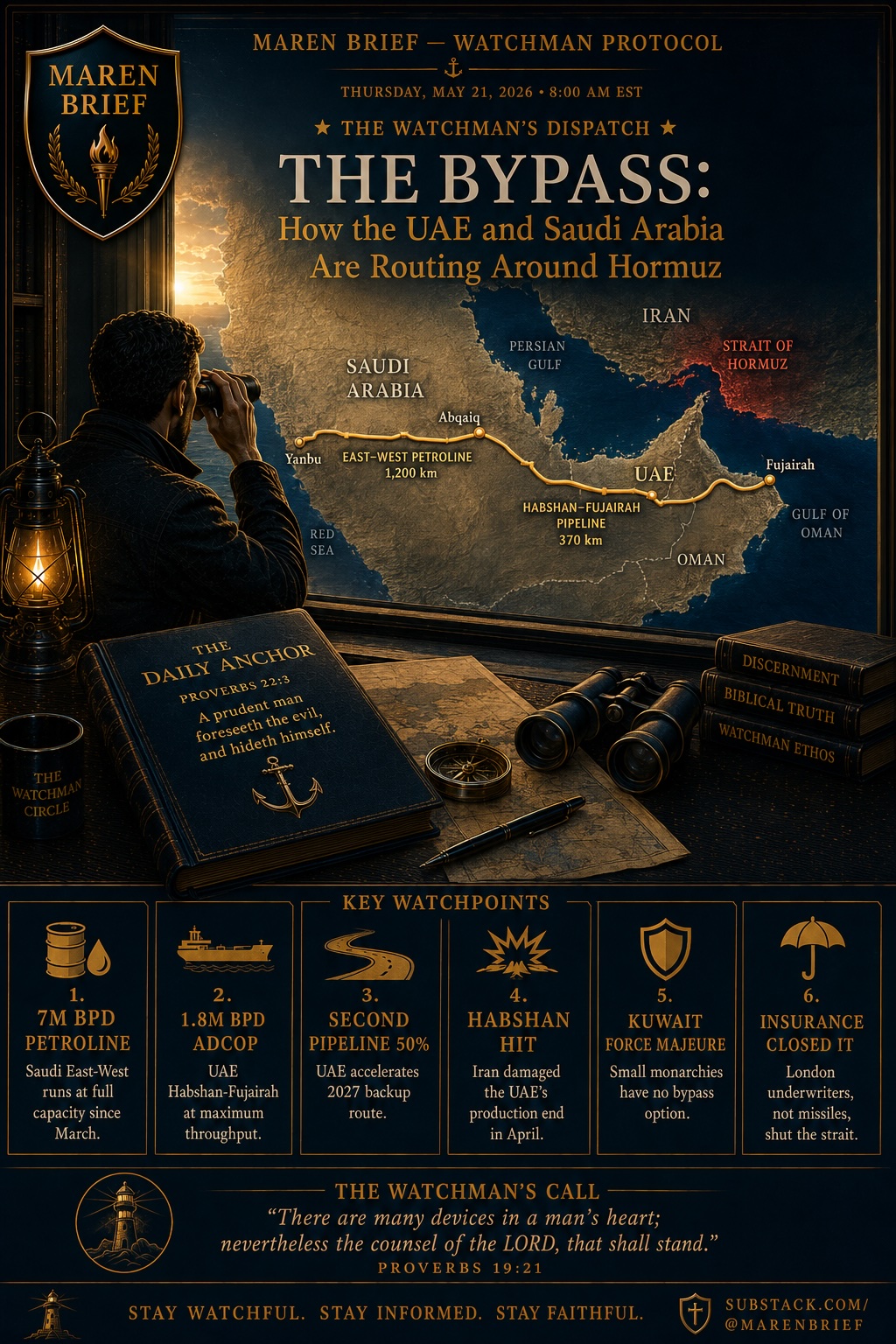
Yesterday's Maren Brief covered the Strait of Hormuz at the chokepoint itself. This morning covers what most analysts treat as a footnote: the existing infrastructure that allows partial Gulf oil to reach world markets without ever transiting Hormuz.
The infrastructure is real. It is also nowhere near enough.
The International Energy Agency confirms only two countries — Saudi Arabia and the United Arab Emirates — have operational crude pipelines that can reroute around the strait. The IEA's estimated bypass capacity range is 3.5 to 5.5 million barrels per day, against pre-crisis Hormuz transit of approximately 20 million barrels per day. The bypass covers, at best, roughly 25 to 30 percent of pre-crisis flow.
Saudi Arabia's 45-Year-Old Answer
The Saudi East-West Pipeline — known in the industry as Petroline — is 1,200 kilometers of buried steel running from the Abqaiq processing complex in the Eastern Province across the full width of the Arabian Peninsula to the Red Sea port of Yanbu. It was commissioned in 1982, in the middle of the Iran-Iraq War, for precisely the scenario Saudi Arabia now faces.
Original design capacity was 5 million barrels per day. After the 2019 Abqaiq drone strikes, capacity was expanded to 7 million barrels per day by converting parallel natural gas liquids lines to crude service. Saudi Aramco CEO Amin Nasser confirmed in late March that the pipeline is now operating at its full 7 million bpd.
The bottleneck, it turns out, is not the pipeline. It is the port. Yanbu handled 47 Very Large Crude Carrier loadings in March 2026 — roughly four times its pre-war monthly average. Pilot boats, berth scheduling, storage tank cycling, and tanker queuing all became binding constraints. Saudi Arabia has been physically capable of delivering more crude to Yanbu than Yanbu can load onto ships. Actual exports through Yanbu are running at approximately 4 to 4.5 million bpd, well below the pipeline's delivery rate.
The 1980s designers built capacity into the pipeline. They did not build it into the port at the same scale. Fixing that imbalance is now an active Saudi capital project — measured in years, not months.
The UAE's More Constrained Answer
The UAE's bypass is more recent and more vulnerable. The Habshan-Fujairah Pipeline (ADCOP) runs approximately 370 kilometers from the Habshan onshore production complex in Abu Dhabi's interior to the port of Fujairah on the Gulf of Oman. Crucially, Fujairah sits east of the Strait of Hormuz — tankers loading there proceed directly into international shipping lanes without ever entering the Persian Gulf.
The pipeline's design capacity is 1.5 million barrels per day, expandable to 1.8 million. It is currently running at or near maximum. But pre-war UAE production was 3.5 million barrels per day. The bypass moves at most 1.8 million. The remaining 1.7 million barrels per day of Emirati output either sits in storage, has been shut in at the wellhead, or attempts the Hormuz transit at war-risk premiums that have shifted the economics of every cargo.
Two complications have made the UAE picture more fragile than Saudi Arabia's.
First, the Habshan gas processing complex sustained significant damage during Iran's April attacks on the UAE. ADNOC Gas confirmed this week that it aims to restore 80 percent of Habshan processing capacity by end of 2026. The strike on Habshan — the production end of the bypass system — was a more sophisticated targeting choice than a strike on the Fujairah port would have been. Iranian planners demonstrated they understand the full kill chain.
Second, the UAE has only one functional bypass pipeline. Saudi Arabia has Petroline plus its eastern oil fields' proximity to alternate Red Sea routing. The UAE is single-pipeline dependent.
On May 20, ADNOC CEO Sultan Al Jaber announced at the Atlantic Council that the UAE's second West-East pipeline is approximately 50 percent complete and accelerated for 2027 delivery. The project will double ADNOC's export capacity through Fujairah. The acceleration is, in essence, redundancy insurance against the exact vulnerability the Habshan strike exposed.
The Real Closing Mechanism
A finding worth its own attention.
Seven letters from London-based marine insurance underwriters — not Iranian missiles — mechanically closed the Strait of Hormuz to commercial shipping. When Lloyd's of London market underwriters withdrew or repriced war-risk coverage for Hormuz transit beyond commercial viability, commercial vessels could no longer legally transit the waterway. Cargo owners could not insure their cargo. Charterers could not insure their ships. Banks could not finance shipments.
Iran's threats and the IRGC's swarm-tactics posture made underwriting impossible. The actual mechanism of closure was financial and legal, not military.
This matters for how the crisis ends. The strait will reopen not when Iran withdraws threats, but when London-market insurers can underwrite the route again at commercially viable premiums. That requires a credible security guarantee — not a ceasefire announcement. Any U.S. or Pakistan-mediated framework that does not produce insurable transit conditions will not reopen the strait, regardless of what either government announces.
The Cost So Far
ADNOC CEO Sultan Al Jaber has been the most consistent public voice quantifying the crisis. On May 12, and reaffirmed at the Atlantic Council on May 20, Al Jaber confirmed cumulative oil supply losses have crossed one billion barrels, with weekly losses of approximately 100 million barrels while the strait remains closed. He called it "the arithmetic of extortion."
The downstream impact, per Al Jaber's data: Airline ticket prices up 20 percent. Fuel costs up 30 percent. Fertilizer prices up 50 percent. Brent crude trading near $100 per barrel — approximately 40 percent above pre-war levels.
Even if Hormuz reopened immediately, Al Jaber estimates four months minimum to ramp oil flows back to 80 percent of normal. Full normalization is unlikely before the first or second quarter of 2027.
The bypass infrastructure is why oil isn't $150. It is also why the crisis can continue indefinitely — Gulf monarchies whose exports flow uninterrupted have less urgency to push for resolution. Iran has read this carefully. So have the Saudis.
The Stewardship Question
This morning's Maren Brief carries Proverbs 22:3: "A prudent man foreseeth the evil, and hideth himself: but the simple pass on, and are punished."
The 1980s Iran-Iraq Tanker War taught every Gulf monarchy a single lesson: a state whose entire economy depends on twenty miles of contested water owns nothing. Saudi Arabia and the UAE took the lesson seriously. The Saudi East-West Pipeline was commissioned in 1982. The UAE's Habshan-Fujairah pipeline opened in 2012. Both were built for precisely this scenario.
The American household, the American business, the American policymaker — each carries the same call. Energy resilience, supply-chain diversification, geographic redundancy. The prudent who foresee the evil prepare. The simple who pass on are punished — not by divine vengeance, but by the consequences they declined to foresee.
Read the Full Brief
The full Maren Brief for this morning continues with the UAE's confirmed OPEC exit and what it means for OPEC+ politics, the Kuwait force majeure precedent and the small-monarchy crisis, Qatar's LNG exposure, the Houthi Red Sea threat to Yanbu, and the biblical framework for strategic preparation under structural constraint.
Most analysis tells you what the chokepoint is doing. The Maren Brief asks what the infrastructure around the chokepoint is — or isn't — able to do.
🔥 ESSENTIAL READING: Strait on Fire: The Hormuz Ultimatum — the Global Chokepoints Series volume that walked through this exact infrastructure question in narrative form before the bypass became headline news. Available at eliasmaren.com.
"There are many devices in a man's heart; nevertheless the counsel of the LORD, that shall stand."
— Proverbs 19:21
Explore the Full Catalog
20+ Titles Available on Amazon
Geopolitical intelligence. Military fiction. Faith-informed analysis. Browse the complete Elias Maren catalog on Amazon.
Visit the Amazon Author Page →
Elias Maren
Geopolitical analyst and author of the Global Chokepoints series, the Aegis Directive thrillers, and Nations in the Valley. Published by CoachDPrep Publishing.